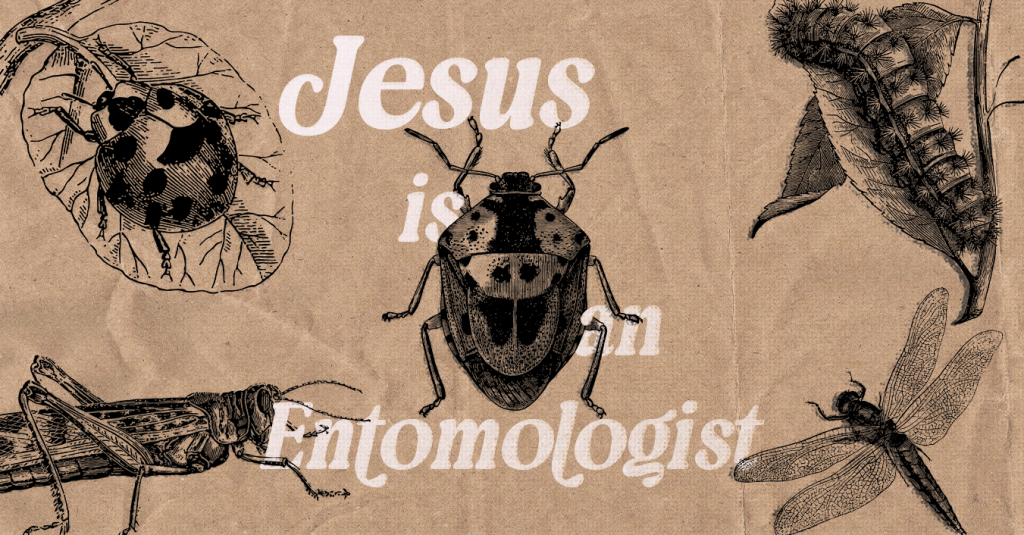
As Easter approaches, and we begin to reflect on Good Friday and Christ’s sacrifice on the cross, we often return to the final words that Jesus spoke. One of the most striking moments is when He cries out, “My God, my God, why have you forsaken me?” (Matthew 27:46).
These are not random words. Jesus is quoting Psalm 22:1.
In that moment, He is pointing back to something His audience would have known well. This was a culture shaped by memorized Scripture. Unless you were a Roman, many of the people standing there would have recognized the line immediately. Some may have misunderstood it as defeat. Others would have heard something deeper. They would have known the rest of the psalm. They would have known where it leads.
In that same psalm, a few verses later, David writes:
“But I am a worm and not a man, scorned by mankind and despised by the people”
Psalm 22:6
When you read that in English, it sounds simple. It’s just exaggerated humility, but there’s more going on underneath the surface. The Hebrew word used there is tolaʿath. It can be translated as worm, but it is also used for a specific kind of insect from that region, likely a type of Kermesidae. It’s not just any worm. It would have been a grub that grows into a small creature that was known, among other things, for its role in producing dye.
When I say the title, “Jesus is an entomologist,” I know that sounds strange at first. An entomologist studies insects. So the natural question is, what does that have to do with Jesus? It starts here.
This tolaʿath bug, in the ancient world, was associated with a deep crimson or scarlet dye. When crushed, it would produce a rich color that was highly valued. This wasn’t just a minor detail in the culture. That same kind of scarlet was used in the tabernacle, in priestly garments, and in sacred spaces tied to the presence of God (Exodus 26:1, Exodus 28:5–6). When David says, “I am a worm,” he may not just be speaking about being low or insignificant. There is an image here of something that is crushed, something that produces a deep red stain, something connected to sacrifice, to priesthood, to the presence of God.
When you look at that through the lens of the cross, it starts to sharpen.
Jesus is not only identifying with human weakness. He is stepping into the role of the one who will be crushed for the sake of our closeness with God. Wow. That’s enough of an analogy to understand it, but it goes deeper. The same word shows up in Exodus with another image.
In Exodus 16:20, when the Israelites are given manna from heaven, God gives them a clear instruction. Take what you need for the day. Do not hoard it. Trust that there will be more tomorrow. That’s a blog post for another day. Just like we don’t listen to that instruction, the Israelites don’t listen either. They keep some of it, and the manna spoils. It becomes infested. The word used there is the same root. The manna becomes filled with tolaʿath.
The same creature connected to sacred dye is also associated with decay and corruption. Jesus calls Himself the bread from heaven (John 6:35). He is the true manna and perfect provision of God. Given daily. Not to be hoarded, but to be received in trust. Yet on the cross, His perfection is infested with our sin, failure, and lack of trust. Everything that corrupts what was meant to be pure.
In that sense, the imagery becomes uncomfortable, but clear. The perfect manna is handed over to what we have done to it. He steps into the place of what has been spoiled. That is why He is crushed.
There is one more layer that pulls all of this together. Some forms of this insect, particularly the scarlet-producing varieties, attach themselves to a tree or wooden surface. They fix themselves in place, and in that position, they reproduce. Depending on the type of Kermesidae, many of them form a type of cocoon that breaks open for birth and food for the young. The life of the next generation comes at the cost of the mother. The young and the tree itself are covered in the crimson color of the mother. Afterward, what remains shifts in color. From deep red, the remains eventually fade toward a pale, almost white residue.
There is some variation in how this is described across species, so it’s worth holding that detail with care. Even so, the imagery is difficult to ignore.
A creature attached to a tree. Giving of itself so that life comes from it. Marked in red, and then fading toward white.
When you lay that alongside the cross, the parallels speak for themselves. Jesus, lifted onto a tree (1 Peter 2:24). Giving Himself fully. Saying, “This is my body, given for you” (Luke 22:19). His blood staining what was once untouched. Our sin marked, then covered.
And then the promise:
“Though your sins are like scarlet, they shall be as white as snow”
Isaiah 1:18
So when David says, “I am a worm,” it is more than a statement of weakness. It becomes a window. A window into sacrifice, provision, and what it means for something pure to take on corruption so that something broken can be made clean.
I always question certain things like why did God make mosquitoes? What’s the purpose of these bugs invading my house? Why would God design something like this? Maybe there’s an analogy we haven’t found with them, but this one gives us something to hold on to. It’s easy to look at creation and wonder about the purpose of small, strange things, but sometimes those details hold images we would have missed otherwise. Here, in something as small as a worm, you get a picture of the cross.
Of something crushed.
Of something stained.
Of something given.
Of something that, in the end, leads to cleansing.
Jesus steps into all of it. In doing so, He gives us more than an answer. He gives us a way to see what He has done, from angles we might have never considered.
I am but a worm.
 Watchmysign